



)


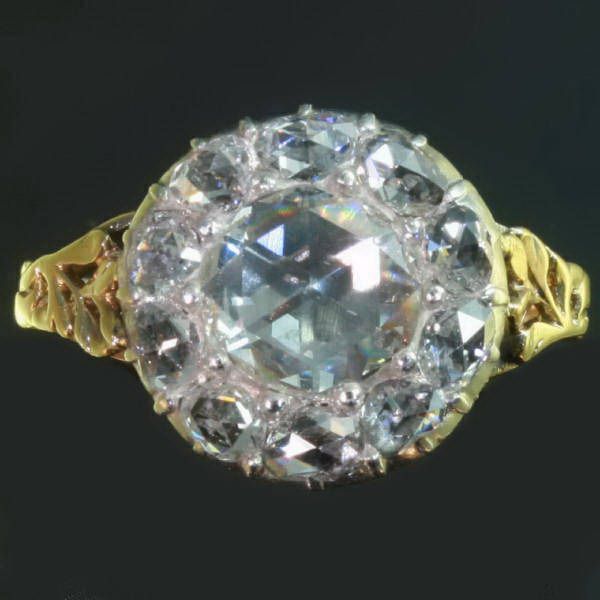
Antique engagement ring with big rose cut diamond engird by smaller rose cuts
Antique engagement ring with big rose cut diamond engird by smaller rose cuts.
Antique jewelry object group: rings
Country of origin: Although it does not carry any legible control marks we believe this to be of Dutch origin.
Style: Victorian
(more info on styles)
Period: ca. 1870
(events and facts in 1870)
Material: Silver on top and backed with 14K
yellow gold (see explanation on
silver on gold).
(more info on precious metals)
Technique: Gold-backed silver or the silver on gold technique. This technique finds its origin centuries ago, when jewelers believed that only a silver mounting could render the true
beauty of a diamond. Backing the silver jewel with a (thin) layer of gold was a practical precaution taken to avoid the silver jewelry leaving black stains on clothing or skin. Over the years, with the recognition (and
thus use) of platinum as precious metal and the development of white gold the practical necessity to use bi-colored material became obsolete. The argument to use bi-colored metals became more an estetic then
a practical one. and The rose cuts are set on foil. This is a special technique that was used to bring the lustre of the diamonds to its best quality.
Extra information:
engagement ring - In Western tradition, an engagement ring is a ring, of
no generally accepted form, worn by a woman indicating her engagement to be married. Conventionally, the ring is presented as a betrothal gift by a man to his prospective bride while he proposes marriage or
directly after she accepts his marriage proposal. It represents a formal agreement to future marriage.
In recent years such rings have normally been set with a gemstone, usually a diamond, as a solitaire,
of varying sizes, cuts, styles, and cost, but in the 19th century some were set with a pearl. In the same century the custom arose in England of separate engagement ring and wedding ring, and in very recent
years such rings have sometimes been made en suite as a matching pair of similar style. In recent years, antique gemstone engagement rings are rapidly gaining in popularity.
In some countries, such
as the United States and the United Kingdom, it is worn on the left-hand ring finger, while in other countries, such as Poland and Ukraine, it is customary for the ring to be worn on the right-hand. Similar traditions
purportedly date to classical times, dating back from an early usage reportedly referring to the fourth finger of the left hand as containing the vena amoris or "vein of love". In the United States and Canada today it
is becoming more common, but still quite rare, that a woman will also buy her partner an engagement ring (also called a pre-engagement ring, promise ring, or 'mangagement' ring) at the time of the engagement.
Diamonds:
One big and 10 smaller ( rose cut diamonds. We do not have the weight of the
diamonds which is normal in our trade when it comes to rose cuts.
Birthstones:
Diamond is the birthstone (or month stone) for
April.
(more info on birthstones)
Hallmarks: No trace.
(more info on hallmarks)
Condition: excellent condition
(more info on our condition scale)
Dimensions: head of the ring 1.30 cm (0.51 inch)
Weight: 3.40 gram (2.19 dwt)
Ring size Continental: 56 & 17¾ , Size US 7½ , Size UK: O½
Resizing: Free resizing (only for extreme resizing we have to charge).
(more info on ring sizes)
Reference Nº: 10074-4251
See also our:
victorian jewelry,
victorian rings,
victorian diamond rings,
victorian rings with rose cut diamonds,
engagement rings,
all our rings,
jewelry with rose cut diamonds,
jewelry with diamond,
latest acquisitions,
antique jewelry,
estate jewelry,
vintage jewelry or
émodern jewelry
Jewelry with birthstones (or month stones) for:
January -
February -
March -
April -
May -
June -
July
August -
September -
October -
November or
December.
Additional information:
jewelry glossary -
wall of fame -
visit us in Antwerp -
subscribe to our mailinglist.
What is antique jewelry? -
What is estate jewelry? -
What is vintage jewelry?
 |
Terms And Conditions |
Site Map |
Blog |
Testimonials |
In Memoriam
|
Terms And Conditions |
Site Map |
Blog |
Testimonials |
In Memoriam