



)


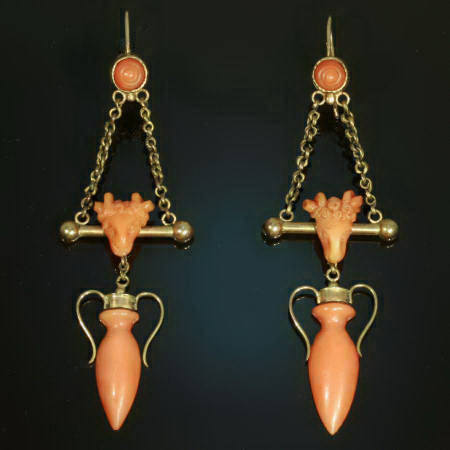
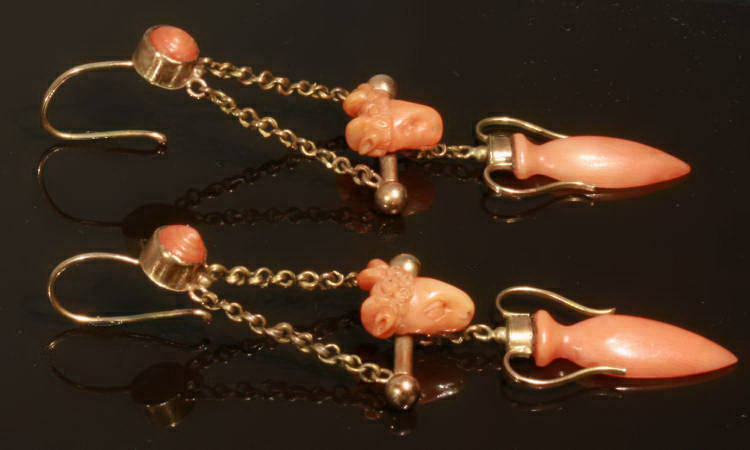
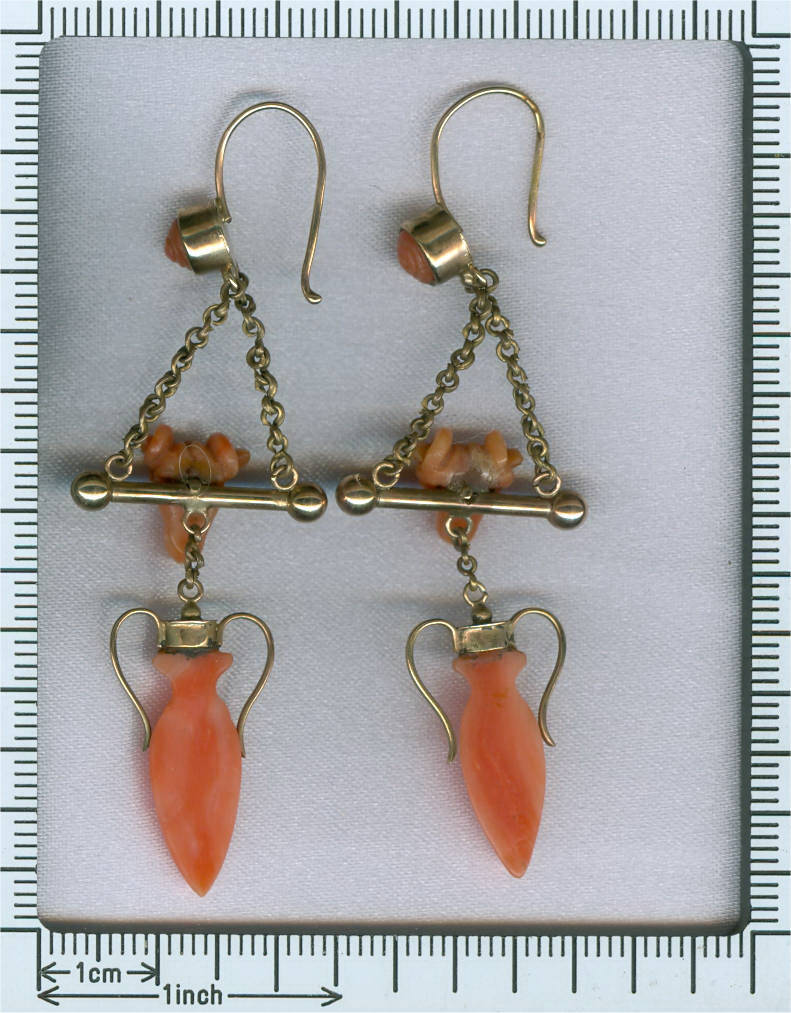
Long pendent Empire earrings with coral ram and amphora
This could represent a ram or faun wearing a vine leaf crown on his head. On the other hand looking at the grape decoration in the hair one could also deduce that the person depicted is Bacchus. Specially the use of the amphora makes us think in this direction.
Antique jewelry object group: earrings
Country of origin: Although it does not carry any legible control marks we believe it to be of Dutch or Belgian origin.
Style: Empire
- (styles overview)
Style specifics: A style that borrowed style specifics from the ancient Greeks and the Roman empire (hence the name of the style:
Empire). The empire period represents the second part of the Neo-Classical style, and shows a strong French influence. The style originated in the desire of Napoleon to
revive the luxurious majesty of imperial Rome. Traditional classical motifs, already seen in the reign of Louis XVI, were supplemented by symbols of imperial grandeur- the
emperor's monogram and his emblem, the bee; representations of military trophies; and after the successful campaigns in Egypt, Egyptian motifs. If we had to characterize
this style briefly, we could focus on two elementary concepts: massiveness and symmetry.
Period: ca. 1810 (events and facts in 1810)
Source of inspiration: mythology
Theme: Bacchus (?) - Roman god of wine
Material: 14K red gold
- (precious metals)
Technique: Cameo is a method of carving, or an item of jewellery or vessel made in this manner. It features a raised (positive) relief image. There are
three main materials for Cameo carving; Shells or Agate (called a Hardstone cameo), and glass. Cameos can be produced by setting a carved relief, such as a portrait, onto
a background of a contrasting colour. This is called an assembled cameo. Alternately, a cameo can be carved directly out of a material with integral layers or banding, such
as (banded) agate or layered glass, where different layers have different colours. Sometimes dyes are used to enhance these colours. Cameos are often worn as jewellery.
Stone cameos of great artistry were made in Greece dating back as far as the 6th century BC. They were very popular in Ancient Rome, and one of the most famous stone
cameos from this period is the Gemma Claudia made for the Emperor Claudius. The technique has since enjoyed periodic revivals, notably in the early Renaissance, and
again in the 17th, 18th and 19th centuries.
Extra information:
Bacchus to the Greek and Dionysus or Dionysos to the Romans, the god of wine, represents not only the intoxicating power of wine, but also its
social and beneficial influences. He is the patron deity of agriculture and the theatre. He was also known as the Liberator (Eleutherios), freeing one from one's normal self, by
madness, ecstasy, or wine. His divine mission was to mingle the music of the aulos and to bring an end to care and worry. There is also an aspect of Dionysus on his
relationship to the "cult of the souls", and the scholar Xavier Riu writes that Dionysus presided over communication between the living and the dead.
Bacchus was the
son of Jupiter (Zeus) and Semele. Juno (Hera), to gratify her resentment against Semele, contrived a plan for her destruction. Jove took the infant Bacchus and gave him in
charge to the Nysacan nymphs and for their care were rewarded by Jupiter. When Bacchus grew up he discovered the culture of the vine and the mode of extracting its
precious juice. Juno struck him with madness but he was cured by the goddess Rhea who taught him how to show the people the cultivation of the vine.
The name
Bacchus came into use in ancient Greece during the 5th century BC. It refers to the cries with which he was worshipped at the Bacchanalia, frenetic celebrations in his
honor. He is viewed as the promoter of civilization, a lawgiver, and lover of peace - as well as the patron deity of agriculture and the theater.
For more information on Bacchus see Wikipedia (opens in new window)
Precious stones:
coral
- (precious stones)
Hallmarks: No trace.
- (general hallmarks info)
Condition: excellent condition
- (our condition scale)
Dimensions: height approximately 6.87 cm (2.70 inch)
Weight: 5.60 gram (3.60 dwt)
Reference Nº: 09177-4324
See also our:
pre victorian jewelry,
victorian jewelry,
victorian earrings,
long pendent earrings,
all earrings
or our latest acquisitions,
antique jewelry,
estate jewelry,
vintage jewelry or
modern jewelry
Jewelry with birthstones (or month stones) for:
January -
February -
March -
April -
May -
June -
July
August -
September -
October -
November or
December.
Additional information:
jewelry glossary -
wall of fame -
visit us in Antwerp -
subscribe to our mailinglist.
What is antique jewelry? -
What is estate jewelry? -
What is vintage jewelry?
 |
Terms And Conditions |
Site Map |
Blog |
Testimonials |
In Memoriam
|
Terms And Conditions |
Site Map |
Blog |
Testimonials |
In Memoriam