



)


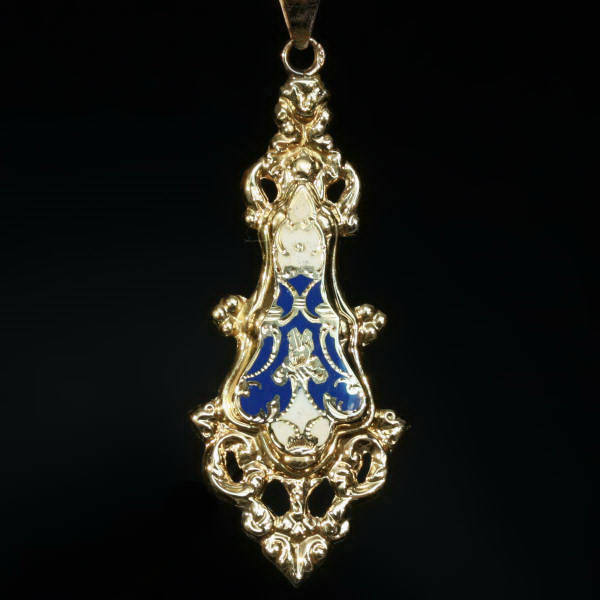
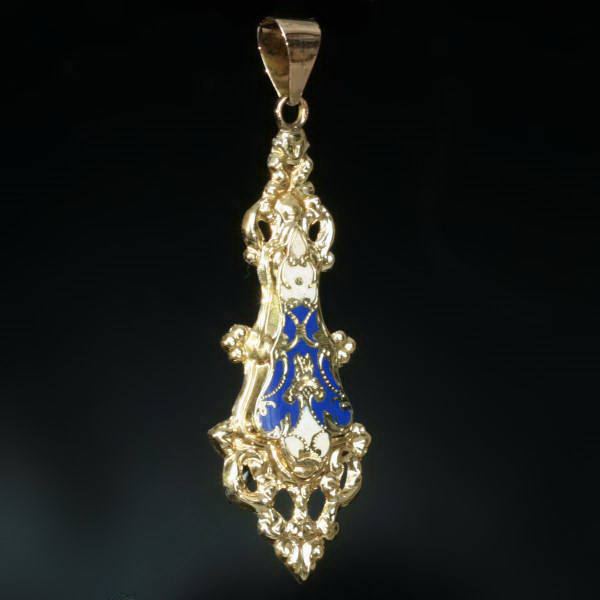
Victorian long gold pendant with white and blue enamel
Antique jewelry object group: pendants
Country of origin:
Although it does not carry any legible control marks we believe this to be of French or Belgian origin.
Style: Victorian
(more info on styles)
Period: ca. 1840
(events and facts in 1840)
Material: 18K yellow gold
(more info on precious metals)
Technique:
Enamelling is an old and widely-adopted technology. The ancient Egyptians applied enamels to pottery and stone objects. The ancient Greeks, Celts, Russians, and Chinese also used enameling processes on metal objects. Enamel is the colorful result of
fusing powdered glass to a substrate by firing, usually between 750 and 850 degrees Celsius. The powder melts and flows and hardens to a smooth, durable vitreous coating on metal, glass or ceramic. According to some sources, the word enamel comes from
the High German word smelzan (to smelt) via the Old French esmail. Used as a noun, "an enamel" is a usually small decorative object, coated with enamel coating, such as a champlevé or a cloisonné (different techniques).
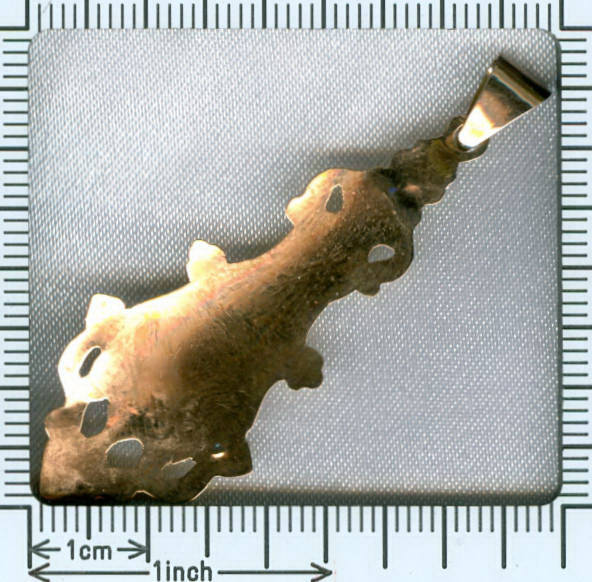
Hallmarks: No trace.
(more info on hallmarks)
Condition: excellent condition
(more info on our condition scale)
Dimensions: height 5.63 cm (2.22 inch)
Weight: 1.40 gram (0.90 dwt)
Reference Nº: 10145-4322
Copyright photography: Adin, fine antique jewelry
See also our:
pendants,
Victorian
jewelry with enamel,
yellow gold jewelry,
latest acquisitions,
antique jewelry,
estate jewelry,
vintage jewelry or
modern jewelry
Jewelry with birthstones (or month stones) for:
January -
February -
March -
April -
May -
June -
July
August -
September -
October -
November or
December.
Additional information:
jewelry glossary -
wall of fame -
visit us in Antwerp -
subscribe to our mailinglist.
What is antique jewelry? -
What is estate jewelry? -
What is vintage jewelry?
 |
Terms And Conditions |
Site Map |
Blog |
Testimonials |
In Memoriam
|
Terms And Conditions |
Site Map |
Blog |
Testimonials |
In Memoriam