



)


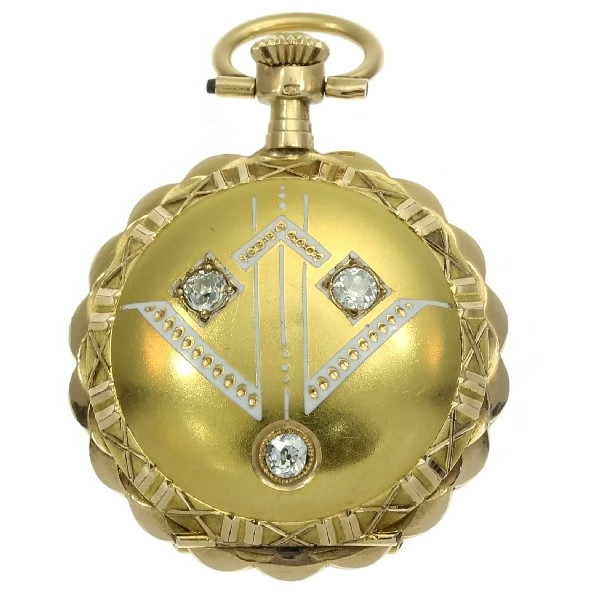
Ladies gold pocket watch a so-called enameled hunter case with old cut diamonds
Antique jewelry object group: ladies pocket watch
Condition: very good condition
- (more info on our condition scale)
Country of origin:
We are not really sure but the origin of this watch could be Poland or the Austrian-Hungarian empire
Style: Something between Art Deco and Belle Époque - Art Deco is an eclectic
artistic and design style which had its origins in Paris in the first decades of the 20th century. The style originated in
the 1920s and continued to be employed until after World War II. The term "art deco" first saw wide use after an exhibition
in 1966, referring to the 1925 Exposition Internationale des Arts Décoratifs et Industriels Modernes that was the
culmination of high-end style moderne in Paris. Led by the best designers in the decorative arts such as fashion, and
interior design, Art Deco affected all areas of design throughout the 1920s and 1930s, including architecture and
industrial design, as well as the visual arts such as painting, the graphic arts and film. At the time, this style was
seen as elegant, glamorous, functional and modern. - See also:
Art Deco.
And the Belle Époque (French for "Beautiful Era") was a period in European social history that began during the late 19th century and lasted until World War I. Occurring during the time of the French Third Republic and the German Empire, the
"Belle Époque" was named in retrospect, when it began to be considered a "golden age" the major powers of Europe, new technologies improved lives and the commercial arts adapted Renaissance and eighteenth-century styles to modern forms. In the
newly rich United States, emerging from the Panic of 1873, the comparable epoch was dubbed the Gilded Age. In the United Kingdom, this epoch overlaps the end of what is called the Victorian Era there and the period named the Edwardian Era.
More info on
styles
Period: ca. 1910
- (events and facts in 1910)
Material: 14K yellow gold
- (more info on precious metals)
Technique:
Enamelling is an old and widely-adopted technology. The ancient Egyptians applied enamels to pottery and stone objects. The ancient Greeks, Celts, Russians, and Chinese also used enameling processes on metal objects. Enamel is the colorful result of
fusing powdered glass to a substrate by firing, usually between 750 and 850 degrees Celsius. The powder melts and flows and hardens to a smooth, durable vitreous coating on metal, glass or ceramic. According to some sources, the word enamel comes from
the High German word smelzan (to smelt) via the Old French esmail. Used as a noun, "an enamel" is a usually small decorative object, coated with enamel coating, such as a champlevé or a cloisonné (different techniques).
Extra information:
The watch falls behind a few minutes per day.
Diamonds:
Three old brilliant cut diamonds with a total estimated weight of approx. 0.24 crt.
Note: All diamond weights, color grades and clarity are approximate since the stones were not removed from their mounts to preserve the integrity of the setting.
Total diamond weight: approx. 0.24 crt. (approximate color and clarity H/I, i)
Birthstones:
Diamond is the birthstone (or month stone) for April.
- (more info on birthstones)
Hallmarks: hallmarks indicating 14K gold
- (more info on hallmarks)
Dimensions: 3.80 cm (1.50 inch) by 2.80 cm (1.10 inch)
Weight: 15.40 gram (9.90 dwt)
Reference Nº: 01183-1356
Copyright photography: Adin, fine antique jewelry
yellow gold jewelry,
jewelry with diamond,
latest acquisitions,
antique jewelry,
estate jewelry,
vintage jewelry or
modern jewelry
Jewelry with birthstones (or month stones) for:
January -
February -
March -
April -
May -
June -
July
August -
September -
October -
November or
December.
Additional information:
jewelry glossary -
wall of fame -
visit us in Antwerp -
subscribe to our mailinglist.
What is antique jewelry? -
What is estate jewelry? -
What is vintage jewelry?
 |
Terms And Conditions |
Site Map |
Blog |
Testimonials |
In Memoriam
|
Terms And Conditions |
Site Map |
Blog |
Testimonials |
In Memoriam