



)


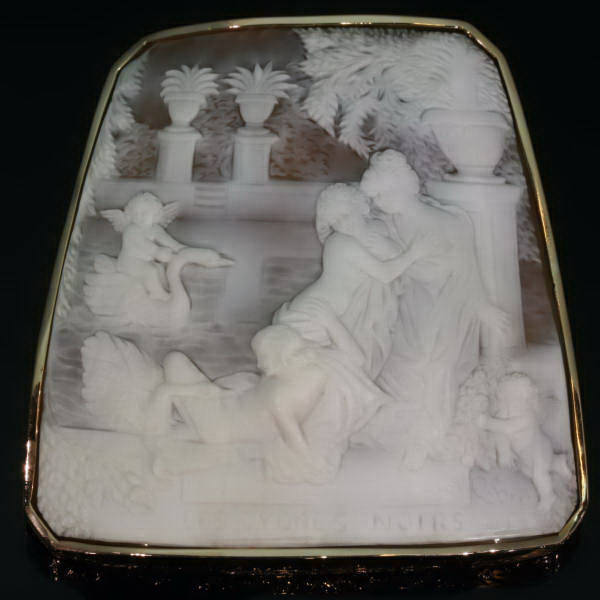
Huge cameo with mythological romantic scene of The Black Swans
An allegory scene is a visual expression (in this case the cameo) of a novel, poem or even mythological story. And this is where our problem starts with this nicely engraved cameo. Although all the figures are clearly recognizable and even a title is given to the work, "Les cygnes noirs" (French for "The black swans"), we do not know what allegoric scene this must be.
Could this be the story of Aphrodite, Persephone and Adonis? Or does it refer to Leda and the Swan? But then what does that have to do with "The black swans"? Perhaps the artist was inspired by Tchaikovsky's Swan Lake? In that ballet there is a black swan, but just one. Or perphaps the engraver was inspired by Wagner’s opera Lohengrin, the story of an heroic Swan Prince, a man with a mysterious past who arrives on a magical swan-boat. But on the cameo there is not a man sitting on a swan but a putti (angel) with wings.
Any help or information you might have that helps us in determining what this story is, is much appreciated.
Other clues we have is something that looks like a name engraved on the front, like "C.Sorre" or "C.Sonne" and a signature on the back that is even harder to decipher. We read something like "RoLarbonepiy" (????) See also the pictures for these names.
Antique jewelry object group: brooch
Condition: excellent condition
- (more info on our condition scale)
Country of origin:
Although it does not carry any legible control marks we believe this to be of Belgian origin.
Style: Estate
- See also: estate jewelry
or more info on styles
Period: ca. 1930
- (events and facts in 1930)
Source of inspiration: Mythology ?
Theme: to be determined
Material: 18K red gold
- (more info on precious metals)
Technique:
Cameo is a method of carving, or an item of jewellery or vessel made in this manner. It features a raised (positive) relief image. There are three main materials for Cameo carving; Shells or Agate (called a Hardstone cameo), and glass. Cameos can be
produced by setting a carved relief, such as a portrait, onto a background of a contrasting colour. This is called an assembled cameo. Alternately, a cameo can be carved directly out of a material with integral layers or banding, such as (banded) agate
or layered glass, where different layers have different colours. Sometimes dyes are used to enhance these colours. Cameos are often worn as jewellery. Stone cameos of great artistry were made in Greece dating back as far as the 6th century BC. They were
very popular in Ancient Rome, and one of the most famous stone cameos from this period is the Gemma Claudia made for the Emperor Claudius. The technique has since enjoyed periodic revivals, notably in the early Renaissance, and again in the 17th, 18th
and 19th centuries.
Precious stones:
cameo
- (more info on precious stones)
Hallmarks: No trace.
- (more info on hallmarks)
Dimensions: width 6.80 cm (2.68 inch), height 6.70 cm (2.64 inch), thickness 1.95 cm (0.77 inch)
Weight: 47.70 gram (30.67 dwt)
Reference Nº: 11116-0013
Copyright photography: Adin, fine antique jewelry
See also our:
all brooches,
jewelry with animals,
all floral jewelry,
jewelry with human motifs,
jewelry with cupids,
mythological jewelry,
red gold jewelry,
cameo jewelry,
latest acquisitions,
antique jewelry,
estate jewelry,
vintage jewelry or
modern jewelry
Jewelry with birthstones (or month stones) for:
January -
February -
March -
April -
May -
June -
July
August -
September -
October -
November or
December.
Additional information:
jewelry glossary -
wall of fame -
visit us in Antwerp -
subscribe to our mailinglist.
What is antique jewelry? -
What is estate jewelry? -
What is vintage jewelry?
 |
Terms And Conditions |
Site Map |
Blog |
Testimonials |
In Memoriam
|
Terms And Conditions |
Site Map |
Blog |
Testimonials |
In Memoriam