



We offer layaway, spread payments on the piece of your dreams. Ask us for details. Free insured shipping on all orders !!!
Antique jewelry glossary
Welcome to our extensive antique jewelry glossary with around 1,500 jewelry related entries.If you feel you are missing an explanation, feel free to let us know and we will add it.
A - B - C - D - E - F - G - H - I - J - K - L - M - N - O - P - Q - R - S - T - U - V - W - X - Y - Z all
Rhinestone
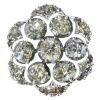
A rhinestone or strass, paste or diamante is a diamond simulant made from rock crystal, glass or acrylic.
Originally, rhinestones were rock crystals gathered from the river Rhine. The availability was greatly increased when around 1775 the Alsatian jeweller Georg Friedrich Strass had the idea to imitate diamonds by coating the lower side of glass with metal powder. Hence, rhinestones are called Strass in many European languages.
Rhinestones may be used as imitations of diamonds, and some manufacturers even capture the glistening effect that real diamonds have in the sun.
In 1955, the "Aurora Borealis" or "Aqua aura", a thin, vacuum-sputtered metallic coating applied to crystal stones to produce an iridescent effect, was introduced. Aurora Borealis tends to reflect whatever color is worn near it, and it is named after the Aurora Borealis atmospheric phenomenon, also known as the Northern Lights.
Typically, crystal rhinestones have been primarily used on costumes, apparel and jewelry. Crystal rhinestones are produced mainly in Austria by Swarovski and in Czech Republic by Preciosa. In USA, these are sometimes called Austrian Crystal.
The rhinestone-studded Nudie suit was invented by Nudie Cohn in the 1940s, an Americanization of the matador's "suit of lights". Liberal use of rhinestones used to be associated with country music singers, as well as with Elvis Presley and Liberace.
From: Wikipedia
Rhinestone
The following is from: An Illustrated Dictionary of Jewelry, autor: Harold Newman, publishers: Thames and Hudson
A variety of rock crystal that is used as an inexpensive imitation of diamond. A misnomer for a colourless, iridescent glass that is so used. In the United States and Canada this misnomer has been sometimes applied to a colourless paste of high lustre, and in England sometimes also to a coloured paste. The French term for true rhinestone is caillou du Rhin.
 |
Terms And Conditions |
Site Map |
Blog |
Testimonials |
In Memoriam
|
Terms And Conditions |
Site Map |
Blog |
Testimonials |
In Memoriam