



)


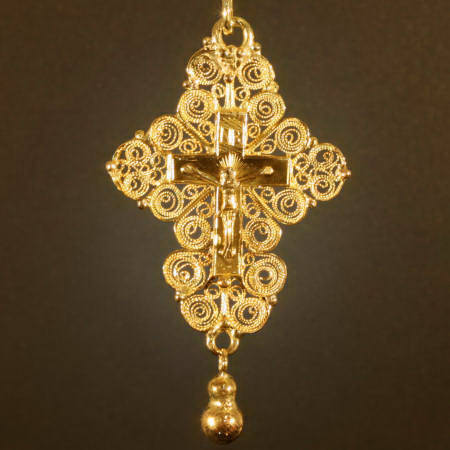
Mid 18th Century gold filigree cross with crucifix
Cross pendant Boulonnaise", figuration of the Christ on gold Latin cross with inscription INRI, openwork, filigree, four shell motifs on the sides of the cross and a "pendeloque" or little gold ball articulated to the main pattern. The cross depicted is called a Saint André cross. The letters "INRI" are the initials for the Latin title that Pontius Pilate had written over the head of Jesus Christ on the cross. Latin was the official language of the Roman Empire. The words were "Iesus Nazarenvs Rex Ivdaeorvm.". The English translation is "Jesus of Nazareth, the King of the Jews."This type of cross was part of the adornment of wealthy fishermen along the coast between Boulogne and Dunkirk in France. They are typical by their shells motifs that evokes the pilgrimage to Saint Jacques de Compostelle and the filigree work is perhaps the mark of a distant Spanish origin. The County of Flanders became Spanish between the 15th and 17th centuries. The curly lines might also evoke twisted ropes wound on the bridge or boats and the shell as product from fishing. The "pendeloque", floats used by fishermen.
These crosses called "Boulonnaise" were also named "croix du pardon" (cross of forgiveness) or "croix flamande" (flamish cross) because their origin would be from Antwerp. This type of cross was worn on a long chain called "sorcière" or witch, several times around the neck and closed with a large closure.
Some fine examples are visible in Paris at the National Museum
Antique jewelry object group: pendants
Country of origin: France
Style: Georgian
- (styles overview)
Period: ca. 1770 (events and facts in 1770)
Source of inspiration: Christianity
Theme: crucifixion - In the Roman era crucifixion was a very common way of executing despised criminals and slaves, and Christianity still was an illegal religion.
By sacrificing himself, Christ liberated man from Adam's sin that had been inherited by the entire humanity. Christ has been depicted leaning his head on his right shoulder,
while wearing the subligaculum (a small strip of cloth) around the waist and the crown of thorn on his head.
Material: 18K yellow gold
- (precious metals)
Technique: Filigree; this is in fact thin gold wire twisted into refined motifs. This technique demands very high skills and precision from the maker.
Hallmarks: Illegible remains of hallmarks that are clearly 18th century French
- (general hallmarks info)
Condition: excellent condition
- (our condition scale)
Dimensions: Height approximately 6.64 cm (2.61 inch)
Weight: 8.40 gram (5.40 dwt)
ReferenceNº: 08328-3223
See also our:
pre victorian jewelry,
christian jewelry,
crosses,
crosses with crucifix,
crosses without crucifix,
jewelry with filigree & granules
or our latest acquisitions,
antique jewelry,
estate jewelry,
vintage jewelry or
modern jewelry
Jewelry with birthstones (or month stones) for:
January -
February -
March -
April -
May -
June -
July
August -
September -
October -
November or
December.
Additional information:
jewelry glossary -
wall of fame -
visit us in Antwerp -
subscribe to our mailinglist.
What is antique jewelry? -
What is estate jewelry? -
What is vintage jewelry?
 |
Terms And Conditions |
Site Map |
Blog |
Testimonials |
In Memoriam
|
Terms And Conditions |
Site Map |
Blog |
Testimonials |
In Memoriam